The Ultimate Comprehensive Engineering Guide to Wire Mesh Cable Trays for Global Infrastructure Projects
In large scale industrial plants, high density data centers, and complex commercial infrastructures, cable management is a cornerstone of operational safety, system longevity, and structural integrity. Historically, heavy duty sheet metal ducts dominated the market. However, modern engineering increasingly demands lightweight, flexible, and thermally efficient solutions. This is where advanced Wire Mesh Cable Trays have revolutionized the sector worldwide.
When delivering global projects, engineering and procurement teams must evaluate systems based not only on material costs but also on Total Cost of Ownership. This comprehensive guide analyzes why innovative fast connecting boltless and screwless Wire Mesh Cable Trays represent the pinnacle of modern cable routing, detailing their technical specifications, financial impacts, and installation mechanics.
Technical Fundamentals of Wire Mesh Cable Trays and Grid Design
Understanding the mechanical properties of your containment system is essential for long term load safety. Wire Mesh Cable Trays are grid based wire structures manufactured from high tensile steel wires, cross welded and shaped into a rugged U channel profile.
This specific geometric design yields an optimal strength to weight ratio. This setup allows the containment system to handle substantial cable loads while remaining remarkably lightweight compared to traditional sheet metal trays or heavy ladder systems.
Material Configurations and Environmental Corrosion Protection
Selecting the correct surface finish for your Wire Mesh Cable Trays network is critical to matching the specific atmospheric conditions of your project according to global ISO 12944 corrosivity categories.
Electro Zinc Plated Finish
Often classified as Electro Galvanized, this option is ideal for controlled indoor environments, commercial offices, and standard IT server rooms where relative humidity remains consistently low.
Pre Galvanized Finish
This option utilizes continuously zinc coated steel wire, offering cost effective, baseline atmospheric corrosion resistance for light industrial factory applications.
Hot Dip Galvanized Finish
The steel structure is completely immersed in a molten zinc bath post manufacturation. This intensive process creates a thick and robust zinc iron alloy layer, making it perfect for harsh outdoor environments, chemical plants, and non climate controlled industrial facilities.
Stainless Steel Configurations
This is the premium choice for highly corrosive or sterile environments. Stainless Steel AISI 304 is widely deployed in food processing and pharmaceutical industries due to its washdown compatibility. Stainless Steel AISI 316L contains molybdenum and provides supreme chemical resistance against aggressive chlorides and marine offshore environments.
Key Structural Advantages Ventilation Hygiene and Field Flexibility
1 Superior Thermal Performance via Continuous Air Circulation
When electrical cables carry current, they generate heat due to internal resistance losses. In enclosed sheet metal trays, this heat builds up continuously, leading to dangerous thermal de rating. This engineering failure forces design teams to either oversize the cable cross sections or accept higher energy losses.
Because Wire Mesh Cable Trays feature an open grid structure, they allow 100 percent continuous air ventilation. This unrestricted airflow naturally dissipates heat, ensuring cables operate at lower temperatures, preserving insulation lifespans, and eliminating the need for expensive cable oversizing.
2 Industrial Hygiene and Dust Mitigation Standards
In food and beverage processing, pharmaceuticals, and cleanroom environments, dust accumulation and moisture retention pose severe contamination risks. Traditional solid bottom trays act as troughs for debris, moisture, and bacteria growth. The skeletal design of Wire Mesh Cable Trays prevents dust accumulation and allows condensation to drain freely, meeting stringent international sanitary standards.
3 Ultimate Construction Field Flexibility
On active construction sites, routing obstacles such as HVAC ducts, structural concrete columns, and unexpected piping are common. Traditional cable trays require pre fabricated elbows, tees, and cross pieces, which delay progress if sudden layout alterations occur.
Conversely, professional Wire Mesh Cable Trays can be adapted dynamically on site. Using a basic asymmetric side action wire cutter, installers can snip specific grid wires to bend, curve, or transition the tray vertically or horizontally in minutes.
Engineering Deep Dive Boltless Fast Connecting Systems vs Traditional Bolted Joints
The most significant evolution in modern wire basket technology is the shift from traditional nut and bolt splice plates to built in fast connecting snap on clamping systems.
The Critical Labor Cost Bottleneck
In a standard 1000 meter installation using traditional bolted couplers, an installation team must manually align couplers, insert bolts, thread nuts, and torque them down at every 3 meter interval. This translates to thousands of small components, high tool dependency, and massive labor hour expenditures.
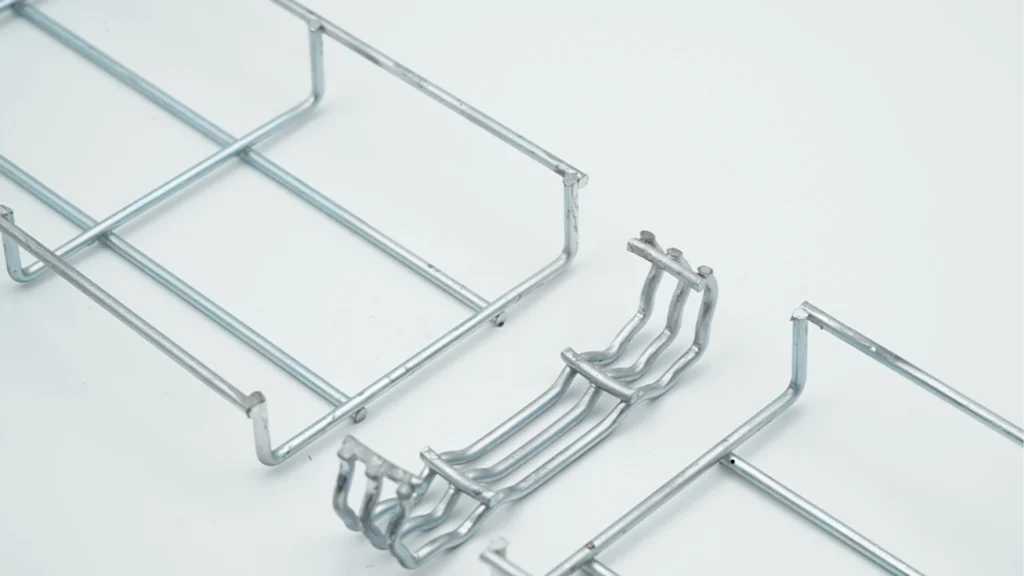
Next generation fast connecting Wire Mesh Cable Trays feature pre engineered interlocking ends or integrated spring steel coupling clips. The installer simply overlaps the wire strands and snaps them into place
[Traditional System] ──► Align Components ──► Insert Bolt ──► Thread Nut ──► Torque (Time 3-4 Mins) [Fast Connect System] ──► Align Tray Grid ──► Snap Lock Click Engagement (Time 15 Seconds)
Detailed Technical and Financial Performance Comparison Matrix
The matrix below highlights the quantifiable differences between traditional bolted sheet metal configurations and next generation fast connecting Wire Mesh Cable Trays networks.
| Technical Metric Parameters | Traditional Bolted Sheet Metal Trays | Fast Connecting Wire Mesh Cable Trays |
|---|---|---|
| Primary Connection Mechanism | Splice plates, M6 or M8 bolts, nuts, and washers | Integrated auto locking clips and snap on couplers |
| Installation Speed Per Joint | Three to five minutes minimum per segment | Fifteen to thirty seconds via manual snap joints |
| On Site Labor Reductions | Baseline standard labor expenditure cost | Forty to fifty percent reduction in man hours |
| Component Management Overhead | High risk of loose hardware loss on site floors | Zero loose hardware needed for straight runs |
| Heat Dissipation Efficiency | Low to moderate due to heat trapping cover traits | Excellent with one hundred percent open airflow |
| Weight Impact on Support Systems | Heavy load requiring beefier brackets and rods | Ultra lightweight reducing structural load by sixty percent |
| Adapting to Field Obstacles | Requires ordering expensive pre made factory fittings | Hand crafted bends on site via basic wire cutters |
| Electrical Grounding Continuity | Depends heavily on dedicated grounding washers | Structural design guarantees built in electrical bonding |
International Engineering Standards and Structural Compliance
When specifying Wire Mesh Cable Trays across major construction blueprints, ensuring compliance with global engineering codes is mandatory to pass strict site audits.
IEC 61537 Compliance
This is the international standard governing cable tray systems and cable ladder systems for cable management. It defines rigorous testing procedures for Safe Working Load capacity, electrical continuity across junctions, and resistance to flame propagation.
NEMA VE 1 and CSA C22.2 No 126.1
The North American standard specifying strict performance requirements, metal manufacturing tolerances, and raw loading capabilities for steel baskets.
UL Classified Certification
This certifies that your chosen Wire Mesh Cable Trays layout serves as an excellent Equipment Grounding Conductor when properly bonded, reducing the need for running continuous separate copper earth wires along the grid runway.
Frequently Asked Questions Concerning Wire Mesh Cable Trays
What are the maximum load bearing limits for wire mesh cable trays
Load capacity depends directly on the wire diameter ranging from 3.5mm to 6.0mm, side rail heights such as 35mm, 50mm, 60mm, or 100mm, and support span distances. When supported at standard intervals of 1.5 meters to 2.0 meters according to IEC 61537, premium Wire Mesh Cable Trays can easily handle heavy power cables without experiencing structural deflection.
Can wire mesh cable trays be safely used for high voltage power cables
Yes they are perfectly suited for high voltage power routing. While they are incredibly popular for low voltage data cables due to the total lack of sharp edges, they perform exceptionally well with power grids. The key requirement is adhering to the correct cable separation metrics and securing cables with appropriate nylon or stainless steel ties to withstand short circuit forces.
How do fast connecting systems maintain electrical bonding and grounding continuity
High quality fast connecting Wire Mesh Cable Trays are designed with integrated high tension spring steel mechanisms. When clicked together, these clips bite into the steel wires under high pressure, maintaining a low resistance electrical connection across the joint. This structural integration easily meets the electrical continuity thresholds outlined in standard IEC 61537.
How do wire mesh cable trays prevent damaging sensitive data cables
Unlike sheet metal profiles that might have sharp burrs from stamping or cutting, quality Wire Mesh Cable Trays are manufactured with a rounded T welded edge safety design. This smooth perimeter prevents the installer from scratching their hands and protects the delicate outer jackets of fiber optic and ethernet cables from stretching or cutting during the pulling phase.
Building a zero maintenance facility infrastructure begins with an adaptable structural path. Explore international load certifications and versatile configuration profiles on the CK Cable Tray Wire Mesh Product Portal or submit your layout blueprints directly to our global engineering desk for custom scalability and material calculations.